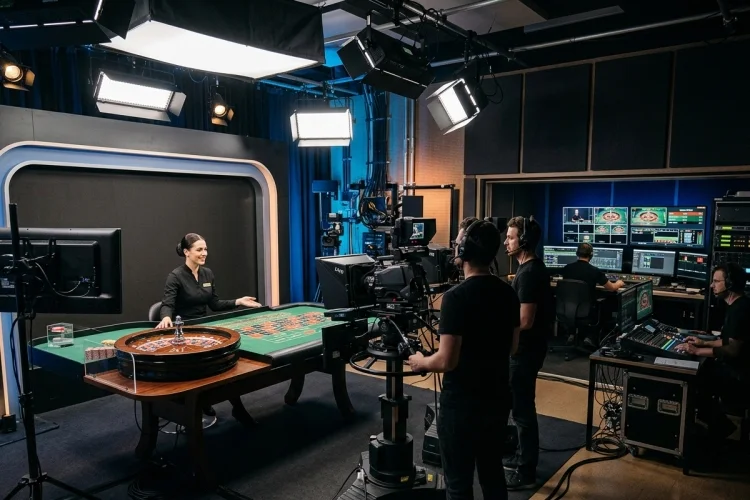
When a live blackjack dealer turns over a card or a roulette ball lands on a number, online players can see the action almost immediately. At the same time, the casino interface updates bets, results, statistics, and account balances.
Understanding How Live Casino Tables Are Filmed and Broadcast means looking at both sides of that process.
The studio must capture a physical casino game accurately, while digital systems convert the action into data and stream it to thousands of possible viewers. Cameras are only the visible part of a much larger real-time production system.
A Live Casino Studio Works Like a Mini TV Network
Live casino providers operate purpose-built environments where gaming and broadcasting happen together.
The tables look similar to those in land-based casinos, but they are surrounded by professional camera, audio, lighting, networking, and monitoring equipment.
Evolution describes its studios as advanced TV or film environments designed specifically for broadcasting live casino games and game shows.
Some operators also run dedicated studio areas created for individual casino brands.
For example, Evolution has previously built branded environments featuring dedicated tables, décor, uniforms, and multi-camera installations for specific operators.
This means what looks like a normal casino room may actually be a carefully controlled production floor.
Cameras Capture More Than One Perspective
Camera selection depends on the type of game.
A blackjack table needs clear views of the dealer and cards. Baccarat may emphasize card-reveal areas, while roulette benefits from views of both the dealer and wheel.
Multi-camera production lets the broadcast switch to whichever angle best explains the current action.
Advanced games may use many more cameras than standard tables.
Evolution’s Immersive Roulette, for example, uses Hollywood-style multiple-camera production and high-frame-rate video to capture close-ups and slow-motion views of the roulette ball.
Standard tables do not necessarily need such dramatic production.
The goal is clarity: players should be able to follow important physical events without constantly guessing what happened off camera.
The Dealer Follows a Structured Workflow
Although live dealers often speak casually, their actions follow documented gaming procedures.
A blackjack dealer must distribute cards in the proper order. Roulette dealers need to manage betting periods and wheel procedures. Baccarat dealers follow specific dealing and drawing rules.
The UK Gambling Commission’s RTS 17 states that live dealer operations must be fair and independently auditable. Dealers should be properly trained according to documented procedures and rules.
Supervision is also part of the process.
Regulatory guidance calls for staff who oversee dealer activity and integrity, alongside surveillance capable of recording activity in sufficient detail.
So even when the presenter is smiling and chatting with players, the underlying operation is tightly controlled.
From Physical Card or Wheel to Digital Result
A live stream alone is not enough.
The software needs to know what happened.
Suppose a roulette ball lands on 17. The system needs to show 17 in the interface, identify the winning bets, update recent-results history, and settle wagers.
A similar process occurs with cards.
Depending on the table, physical outcomes can be captured using specialized sensors, electronic card-reading equipment, optical recognition, manual validation, or combinations of these technologies.
The exact implementation is provider-specific.
What matters is the connection between physical events and digital records.
Regulated live dealer operations must also maintain appropriate equipment integrity and game logs so events can be checked and audited.
That digital trail is one of the key differences between an ordinary broadcast and an interactive gambling stream.
Betting Data Travels Separately From the Video
When you tap a roulette number or select Double in blackjack, your action is not physically placed on the dealer’s table.
It is sent electronically through the gaming platform.
The studio video and the player’s betting interface therefore represent two synchronized channels.
One tells you what is happening physically. The other records what you have chosen digitally.
During roulette, for example, hundreds of online players could place different wagers while watching the same physical wheel.
The dealer does not need a mountain of physical chips representing every remote bet.
Instead, those wagers exist within the gaming system and are settled after the physical outcome has been recorded.
This separation is what allows one broadcast table to potentially serve many remote players simultaneously.
Why Betting Timers Are Necessary
Live casino tables operate continuously, so software needs a clear moment when new bets stop being accepted.
That is why players see countdowns such as “Place Your Bets” followed by “Betting Closed.”
The timer helps keep digital wagers synchronized with the physical game.
Without a cutoff, someone watching a delayed stream could potentially attempt to submit a wager after an important physical event had already occurred.
Latency makes this even more important.
The UK Gambling Commission requires operators to address situations where network delay or device performance could create an unfair disadvantage in time-critical gaming.
The exact technical implementation varies, but the principle is straightforward: wager acceptance must be controlled relative to the live event.
How Streaming Servers Deliver the Broadcast
Raw studio video is too large and impractical to send directly to every player.
Instead, it is processed and encoded for online delivery.
The resulting stream travels through network infrastructure before reaching the user’s browser or app.
Different devices may receive an interface optimized for their screen size, while stream quality can adapt according to the network.
Evolution says players access its live-streamed games using phones or computers while software overlays handle bets, decisions, and chat.
This system can serve players in many locations without requiring everyone to connect directly to the studio camera equipment.
The process happens continously, often for tables that run across long operating hours.
What Happens When the Connection Drops?
A lost connection creates an interesting problem because the physical game may continue even if the player’s video freezes.
The operator therefore needs rules for interrupted gambling.
If a wager was already accepted before the connection failed, the system may still have a valid record of it even if the player cannot watch the outcome live.
If an action was never successfully received, the result can be different.
This is why casino interfaces usually show whether a wager has actually been confirmed.
The underlying game records are more important than what happened visually on the player’s screen.
Good system design should also keep records of current game state and results, areas covered by the broader remote-gambling security framework.
Players should consult the operator’s interrupted-game rules for the exact procedure.
Surveillance Protects the Physical Side of the Game
The livestream gives players visibility, but it is not the studio’s only record.
Separate monitoring systems can capture dealer actions, cards, wheels, and gaming areas for oversight purposes.
The UK Gambling Commission explicitly calls for video surveillance covering predefined live dealer gaming areas with enough detail to establish whether game rules and procedures were followed.
Equipment should also be monitored for integrity.
Secure areas and gaming consumables should only be accessible to authorized staff.
This creates multiple layers of control.
The public-facing camera makes the game viewable, while internal surveillance and logs make operations reviewable.
That difference is easy to overlook when watching from a smartphone.
Cybersecurity Protects the Digital Side
The physical studio is only half the security picture.
Player balances, wager records, authentication details, game states, and communication networks all exist digitally.
The UK Gambling Commission’s remote security standards apply controls to systems that process sensitive customer information, account balances, authentication data, game results, and other critical components. Those requirements draw on relevant elements of ISO/IEC 27001:2022.
This means secure live casino operation involves both physical and digital controls.
Locking down a studio door would not be enough if account or game-state systems were insecure.
Likewise, strong encryption alone would not solve problems with poor dealer procedures.
Both sides need to work together.
Why Live Casino Broadcasts Feel Almost Instant
“Live” does not mean mathematically zero delay.
Every stage takes some time: camera capture, encoding, network transmission, decoding, interface updates, and return communication from the player.
The system is designed to keep that delay small enough for real-time interaction.
Modern live games therefore feel similar to watching a television broadcast while also interacting with it.
The difference is that each action can affect a financial wager, which makes timing far more important than in ordinary entertainment streaming.
That is why professional live casino systems combine fast broadcast technology with bet timers, server-side records, and latency controls.
The stream may look effortless, but maintaining that synchronizaton is one of the hardest technical parts of the operation.
How Studios Support Large Numbers of Tables
Large providers operate many tables at the same time.
Evolution currently says its network includes more than 2,000 live tables for licensed operators worldwide, supported by studios and production hubs in multiple markets.
Each table can have its own dealer, cameras, equipment, interface configuration, language, betting limits, and operator branding.
Some tables may be shared across multiple online casinos, while others are dedicated to one operator.
Behind the scenes, scheduling systems, studio supervisors, technical teams, and dealer rotations help keep that production running.
This scale makes live casino closer to a broadcast network than a single online game server.
Live casino broadcasting combines physical tables, trained dealers, camera production, result-tracking technology, streaming servers, wager systems, surveillance, and cybersecurity.
Video shows the action, while separate digital systems record and settle player decisions. The next time a live table loads in seconds, remember how many systems are working together behind it.
Checking game rules and connection status can also help you understand what happens when the broadcast is delayed or interrupted.