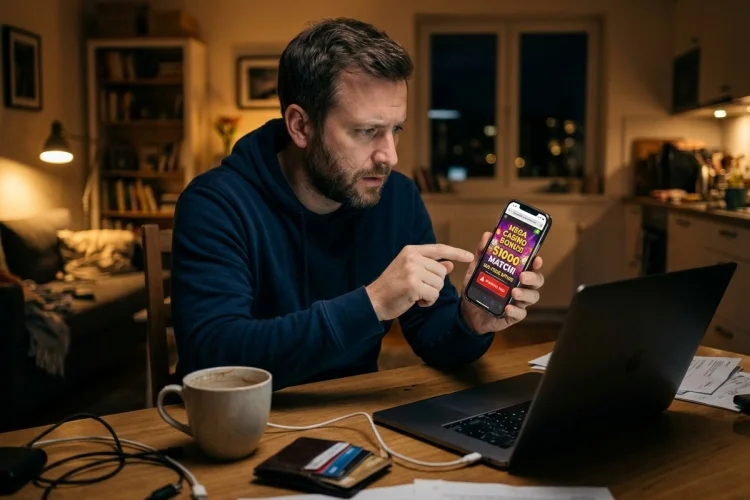
The safest time to discover a suspicious casino bonus is before any money leaves your account. Once you have deposited funds, uploaded identification, or reused a password on a fake website, solving the problem becomes much harder.
Knowing How to Avoid Casino Bonus Scams therefore requires more than checking whether an offer sounds generous. You need to verify the operator, understand the promotion, inspect the payment request, and know which withdrawal conditions are normal.
Scammers often imitate legitimate casino procedures, so the details matter more than the professional-looking banner.
Start by Checking the Exact Website Domain
One of the easiest scams to fall for is a cloned casino website.
A fraudulent site can copy graphics, game thumbnails, promotional banners, and even the wording of a genuine operator.
The web address is harder to copy exactly.
Great Britain’s Gambling Commission advises users to check a gambling site’s licensed status and compare its domain details with the official public register before transferring money.
The same principle applies elsewhere: identify the relevant regulator and verify the website through the regulator’s own records.
Do not reach a casino from a random social-media advertisement and immediately assume it is official.
Open the regulator separately or manually type the known operator address.
An extra letter in the domain can make the difference between the real site and a convincing imitation.
Do Not Confuse a Bad Bonus With a Scam
A legitimate casino bonus can still be unattractive.
High wagering, short expiry periods, low game contribution, maximum bets, or limited withdrawals can make an offer less useful than it first appears.
That does not automatically make it fraudulent.
The difference is transparency.
British regulatory rules require licensed operators to provide clear, fair, transparent, and readily accessible incentive conditions.
Advertising guidance also says major conditions such as eligibility, wagering, time limits, and deposit requirements should be communicated prominently where necessary to avoid misleading customers.
A suspicious operator may advertise “$1,000 FREE” while making the real conditions almost impossible to locate.
A legitimate promotion should let you understand what you are accepting before you deposit.
Calculate the Bonus Instead of Reading the Headline
Promotional percentages can distract from the real numbers.
Imagine two casinos advertising a $100 bonus.
Casino A has a straightforward 5x wagering requirement. Casino B uses 40x, excludes your preferred games, and limits bets during wagering.
Those offers are clearly not equivalent.
Check the wagering formula, game contribution, maximum bet, bonus expiry, minimum deposit, and maximum cashout where applicable.
Great Britain now caps bonus wagering requirements at 10x for operators regulated there, effective January 19, 2026.
Other jurisdictions may permit different terms.
The goal is not to find one universal “good” multiplier. It is to know what the specific offer actually requires.
If the operator cannot explain that clearly, think twice before depositing.
Watch for Fake Customer-Support Accounts
Scammers frequently impersonate customer support.
A message may arrive through Telegram, WhatsApp, Instagram, or another platform claiming that your bonus account needs urgent attention.
The person may know the casino’s name and even copy its profile picture.
They might ask for your password, one-time authentication code, bank details, crypto transfer, or identity documents.
Do not trust the account simply because the logo looks correct.
Contact the casino through the official website and ask whether the message is genuine.
The NCSC notes that criminals regularly impersonate trusted organisations through email, texts, calls, and social media. Modern scams can look convincing enough to fool experienced users.
Real support staff should not need your account password.
Be Careful With “Bonus Verification Fees”
Verification is real. Paying an unexpected fee to unlock a prize is something very different.
A scammer may say your $2,000 bonus withdrawal has been approved but requires a $100 “AML fee,” “international tax,” or “wallet activation charge.”
The FTC’s prize-scam guidance highlights this exact pattern in other prize contexts: scammers promise rewards and then demand money for processing, taxes, shipping, or other invented charges.
That warning translates well to fake casino promotions.
If the claimed casino demands payment, independently contact the verified operator and ask whether the fee exists in its published terms.
Never send cryptocurrency to an individual’s wallet address merely because a chat representative claims the withdrawal cannot proceed otherwise.
Crypto transfers can be very difficult to reverse.
Check Whether Your Own Deposit Is Being Held Hostage
Bonus funds can carry restrictions.
Your ordinary deposit should be treated separately where applicable regulations require it.
Great Britain’s rules provide a useful example: licensed operators must allow customers to withdraw deposit balances even when a bonus is active, except where general regulatory obligations legitimately require restrictions.
The Gambling Commission also tells consumers that operators should clearly distinguish money deposited by the player from restricted promotional funds.
Other markets may have different requirements.
Still, a casino saying “you can never withdraw your original deposit unless you wager 100 times” should prompt careful investigation.
Read the terms and compare them with the consumer-protection rules of the casino’s claimed regulator.
If the casino’s licence cannot be verified, do not assume its withdrawal promises mean anything.
Fake KYC Can Be More Dangerous Than Losing a Deposit
Some scam sites are interested in identity documents as much as money.
A fraudulent casino may ask for a passport, driver’s licence, selfie, utility bill, credit-card image, and bank statement.
Those documents can be valuable for identity fraud.
Legitimate regulated casinos can require KYC, but requests should come through official, secure account channels.
Never upload documents merely because an unsolicited email says, “Verify now to unlock 500 free spins.”
Instead, log into the legitimate site through a known address.
Check whether the request appears there.
If the site’s KYC page looks unusual or redirects to a completely unrelated domain, contact support before proceeding.
The extra minute spent confirming the request is safer than sending personal data to the wrong recipient.
Do Not Believe Guaranteed Withdrawal Claims
Casino games involve risk.
A promotion promising “guaranteed profit,” “100% guaranteed withdrawal,” or “you cannot lose” deserves skepticism.
Even legitimate cashback and bonus promotions have terms and do not guarantee profitable gambling.
Advertising regulators in Great Britain warn that operators should not describe promotions in misleading ways or call something “free” where customers must risk their own money to qualify.
A scam might take this further with claims such as:
“Deposit $200 and receive a guaranteed $1,000 withdrawl after ten spins.”
That is not how ordinary casino bonus mathematics work.
Claims of guaranteed profit are especially suspicious when combined with urgency and unconventional payments.
Avoid Bonuses Delivered Through Suspicious Downloads
A fake promotion may tell you to install an APK, browser extension, “casino wallet,” or verification program.
Be careful.
The NCSC warns that malicious websites and phishing communications can lead users to pages designed to steal personal information or install harmful software.
If the operator has an official application, obtain it through the operator’s verified website or legitimate app-distribution channel.
Do not install files sent directly through chat.
A bonus should not require you to disable antivirus protection, ignore browser warnings, or grant remote control of your computer.
Those instructions are far more consistent with fraud or malware than with a standard casino promotion.
Search Beyond the Casino’s Own Website
A scam site controls everything written on its own pages.
That includes fabricated testimonials and fake licence badges.
Check independent sources.
Search the licensing register, regulator warnings, complaints, and the exact domain name. The Gambling Commission’s public register can also show regulatory action against businesses it oversees.
Consumer-protection agencies similarly recommend independently researching organisations that make unexpected prize claims.
The FTC advises searching a company or promotion name alongside terms such as “complaint” or “scam” when something feels suspicious.
Reviews alone are not proof either, since they can be manipulated.
Use them as one signal alongside licensing and regulatory information.
If You Already Sent Money, Act Quickly
Do not keep sending money because someone promises that one final payment will release everything.
That can turn one loss into several.
The FTC warns about recovery scams that specifically target people who have already lost money and then promise to recover it for another upfront fee.
Contact your bank, card issuer, e-wallet, or payment provider as quickly as possible.
Change passwords if you entered them on a suspicious website, particularly if you reused those passwords elsewhere.
If identification documents were exposed, follow the identity-theft procedures available in your country.
Report the website to the relevant gambling regulator, consumer-protection authority, and cybercrime reporting channel.
The faster you respond, the better your chances of limiting further damage.
Casino bonus scams often imitate legitimate promotions, KYC checks, customer support, and withdrawal procedures.
The best protection is independent verification: confirm the domain and licence, calculate the bonus terms, and question unusual payment or document requests.
Never let an “expiring bonus” rush you into depositing. Verify first, use official channels, and walk away when the operator cannot clearly explain its rules.