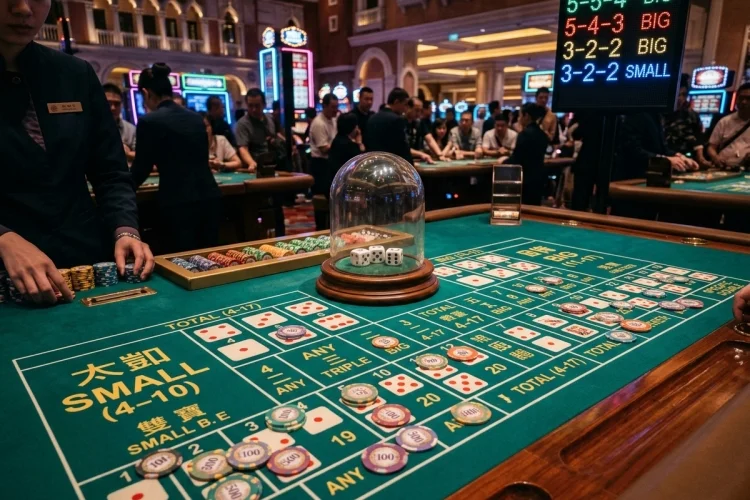
The first time you see a three-dice betting board, it may look like several casino games squeezed onto one table. There are totals in the center, matching dice near the top, and individual numbers along the bottom.
Every area represents a different prediction about the same roll. Learning Sic Bo is mainly about understanding how broad or precise each bet is.
Broad wagers cover more outcomes and normally pay less. Specific predictions can offer much larger returns, but they win less frequently. Here is how the major betting groups work.
Begin With the Dice Result
Every standard round uses three six-sided dice. Once the betting period closes, the dice are shaken and the result is read from their upper faces.
Suppose the result is 2-4-5. The combined total is 11, so Big wins. Odd also wins because 11 is odd. Bets on two, four, or five may succeed, along with a Two-Dice Combination such as 2-5.
One roll can therefore settle several betting areas at the same time.
Big, Small, Odd, and Even
Big and Small are among the broadest choices. Small covers totals from 4 through 10, while Big covers 11 through 17.
Both commonly pay even money, but they lose whenever the result is a triple. Under standard analyzed rules, their winning probability is approximately 48.61%, producing a house edge of about 2.78%.
Odd and Even use the same triple exception on layouts where they are available. A 1-to-1 payout therefore does not mean the wager has an exact 50% chance of winning.
Exact-Total Wagers
An exact-total bet wins only when the three dice add up to the chosen value. A wager on eight, for example, can win on combinations such as 1-1-6, 1-2-5, 1-3-4, 2-2-4, or 2-3-3.
Middle totals can be created in more ways than extreme numbers. This is why totals such as 10 and 11 usually pay less than 4 and 17.
Payout schedules are not identical. Regulated examples list 4 and 17 at returns ranging from 50 to 1 to 64 to 1, depending on the table rules.
Single-Number Bets
A Single Number wager covers one face from one through six. Selecting five wins whenever at least one die shows five.
The return normally increases with the number of matches. A typical structure pays 1 to 1 when the number appears once and 2 to 1 when it appears twice.
The payout for three matches varies. Some schedules pay 3 to 1, while an Australian table may offer 12 to 1. This difference affects the bet’s overall mathematical value.
Two-Dice Combinations
A Two-Dice Combination uses two different numbers. A 3-6 wager wins when both three and six appear among the result, regardless of the third die.
For example, 3-3-6, 1-3-6, and 3-6-6 can all qualify. Published schedules include payouts of 5 to 1 and 6 to 1.
Do not confuse this wager with a Specific Double. A double uses two matching numbers rather than two different faces.
Specific Doubles
A Specific Double predicts that at least two dice will show one selected value. Betting on double four requires a result containing two or more fours.
Depending on the table, the payout may range from 8 to 1 to 11.5 to 1. The bet may still win when all three dice show the number, although the return does not necessarily increase.
Any Triple and Specific Triple
Any Triple covers every result in which all three dice match. A Specific Triple covers only one chosen result, such as 2-2-2.
Because Any Triple covers six possibilities, it pays less. Published figures include 24 to 1, 31 to 1, and 32 to 1. Specific Triple payouts can range from 150 to 1 to 195 to 1 under different regulated schedules.
The largest displayed payout is not automatically the best bet. It must be considered alongside the probability of winning.
Sic Bo offers several ways to predict a single three-dice result. Broad wagers cover ranges or parity, totals target one sum, and number, combination, double, or triple bets require increasingly precise outcomes.
Open the help screen whenever you try a new table because betting names and returns are not fully standardized. Confirm the triple exception, compare every payout, and decide your maximum stake before betting begins.
Treat each wager as an entertainment expense, avoid chasing losses, and never assume that a rare result becomes more likely simply because it has not appeared recently.